
The 15-M movement is a clear example of an emerging Social Redarchy, a new cultural and technological paradigm – and a new way of organizing in society – that has no planned destiny, nor a specific ideological approach, and which, nevertheless, extends without limits. It does so driven by the transparency of global and open networks, which have exposed the gap that separates the expectations of citizens on the one hand and the interests and power struggles of the dominant political elites on the other.
We are witnessing new social movements with great impact. They are unplanned movements, which take different forms, values and beliefs; Authentic Black Swans Regardless of whether they show their outrage at political corruption, defend a fairer world, demand decent work, reject global banking, or propose new alternative ways of life, they have a clear point in common: they constitute a social counter-power.
We are, without a doubt, facing a new social paradigm that some advanced researchers of the network society, such as Castells, had already announced to us: “The elites and dominant structures will be overtaken by the new social movements, which base their legitimacy on transparency and trust.” In short, the 15-M movement places us before a reality of widespread social indignation and rejection, which raises serious questions about our current political system, and poses us with future challenges that are possibly beyond the capacities of our current institutions.
As well as the Redarchy It has given us – as we have seen in previous conversations – the key to understanding the impact of social networks on the structures of our organizations, in today’s reflection we will see how the characteristics of the new social movements also point to the birth of a new emerging social order.
Social Redarchy as a New Emerging Order
We need new words to reflect the new reality. The Social Redarchy is a new cultural and technological paradigm that breaks with traditional structures, and with historical institutions such as parties, trade unions and professional associations, which emerged in industrial society. The Social Redarchy thus constitutes a new social order specific to our network society, which emerges as a result of the new social relations in global and horizontal communication networks.
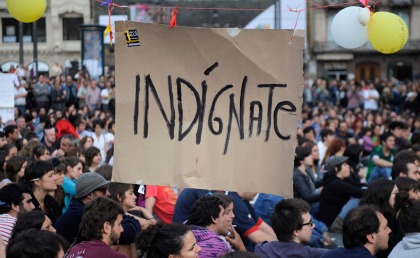 To the extent that we construct our life experiences in networked communication relationships – for example, through Twitter or Facebook – the new order emerges without a particular direction or purpose, as a consequence of the relationships themselves. In a way, it is the dynamics of the relationships themselves that determine the final outcome of the relationships. Hence the confusion of the political commentators and analysts, who examine the movement in vain, obsessed with finding a political intention, and with guessing who benefits from each action and each demand.
Social Redarchy, as a form of autonomous organization, makes it possible to challenge the established powers, and to question the traditional means of mass communication, controlled by economic elites, institutions and local governments. This is how citizens become actors in the new social reality. And this is how politicians – engaged in their power struggles – stop deciding what is important, and what are the real challenges and priorities of society.
The 15-M movement, an example of Social Redarchy
Many qualifiers have been given to the 15-M movement. Personally, I believe that it is not a revolution in the strict sense of the word, since there is no revolutionary ideal, nor clear objectives of violent rupture with the established order. Nor do I think it is a movement specific to Spain. In fact, I dare to say that we will see movements similar to 15-M in other countries in Europe and Latin America, because what we are experiencing is a growing delegitimization of institutions at all levels, local, European and global.
Protest – beyond the conspiracies imagined or dreamed up by some commentators attached to heavily politicized media – is above all a Social Redarchy that emerges autonomously, without individual leaders; A collective action that gathers and shows the citizens’ indignation at the consequences of the economic crisis, the management that governments have made of it, and the delegitimization of the political system.
The 15-M movement thus emerges outside the consolidated hierarchical institutions – whether parties or unions – and relies on social networks and the new communication possibilities offered by Twitter and Facebook, ideal platforms for debate, mobilisation and planning of collective actions.
The mobilizations occupy not only the flows of information that make up the Internet, but also the physical spaces of squares and emblematic places. That is why we can say that the action takes place not only in the virtual world – in which it extends without limits – but also in the physical world.
Digital Natives Enter Politics
One of the most significant features of the events we are experiencing is the active participation of young people in political action. This is a first generation of digital natives, for whom the Internet, social networks, Facebook or Twitter are not a mere technology, but “their own operating system”, a key piece in their way of interpreting the world. Without any doubt, this is going to have a radical impact on your values and future expectations.
This new generation of citizens is clear that the social order must be built from the bottom up, based on the added value to the community – as happens on the Internet – and that it must not continue to be a hierarchical and unidirectional order, emanating from the top of the pyramid, imposed by force from the top down. For this generation, ideas must have equal opportunities; That is, they must be able to gain ground on the basis of their intrinsic merits, and not at the behest of the political power of their sponsors, as they have done so far.
As is already the case on the Web, for digital natives, each person’s real contribution to the community counts infinitely more than the “credentials” displayed. The problem is that the current political system is not willing to take on this new paradigm. For this reason, young people will simply look for organizations in which they can work and contribute according to these new parameters, and will discard those outdated structures based on the traditional “command and control”.
In short, a new generation has come of age and taken the political initiative. This process is irreversible.
Politics 2.0: Citizens are in charge
A new model of economy such as the one we are experiencing – networked, global and hyper-competitive – necessarily requires a new way of doing politics. And the fact is that, due to its own decentralized structure, the Social Redarchy represents a considerable increase in the power of citizens, who obtain the real capacity to challenge and, sometimes, successfully change specific policies, and even institutionalized power relations in society itself.
The Social Redarchy – indissoluble from transparency and the free flow of information – exposes social injustices and the moral misery of corrupt politicians. In addition, it gives citizens the real possibility of transforming reality and setting political priorities, always through awareness and collective mobilization.
By way of summary
In conclusion, the 15-M movement is a clear example – perhaps one of the first – of the new organizational paradigm that we have called Social Redarchy. This is, without a doubt, an unforeseen and far-reaching phenomenon. That’s why, to understand it, what we still DON’T know is probably more important than what we actually know about this new generation of young digital natives. The emergence of young people has once again become an actor and a driving force for change, and I believe that it is now an irreversible phenomenon.
The question is how we are going to translate their outrage into political action. Perhaps the most desirable thing is for the current political parties to take up those proposals of the 15-M platform that are really the majority in society. And this leads us, directly, to another of the key questions: Do today’s political parties have the capacity to reinvent themselves, that is, to think of new models of political representation that are more responsible, more open, and less aimed at unconditional obedience, party discipline and the management of the apparatus?
The mental models with which we operate are obsolete, and the systemic changes we are experiencing are of such complexity that they require collective intelligence to resolve. That is precisely the true value of Policy 2.0: it is not about pretending that we have the answers – we don’t – but about having the humility and courage to recognize that the changes we face are beyond our current capabilities. The most important thing is to create a new political environment that makes it possible for everyone to participate – particularly young people – in the search for innovative solutions to the enormous challenges we face.
Discover more from José Cabrera
Subscribe to get the latest posts sent to your email.


