
“Elites and dominant structures will be overwhelmed by new social movements, which base their legitimacy on authenticity and transparency.” Manuel Castells 2002
Manuel Castells has been anticipating many of the changes we are experiencing for years and shedding light on the transformative power of new social media in a networked society. In his new book. Networks of indignation and hope, the renowned sociologist travels as an “observer” through the most relevant social movements of recent years – the uprisings in Arab countries, the social mobilizations in Iceland, the 15-M Movement in Spain and Occupy Wall Street in the United States – analyzing their origins, values, characteristics and their impact on social change.
From his experience and observation, the author concludes, as a fundamental thesis of his book, that these new movements are a new type of networked social movements, promoted and disseminated on the Internet, and representative of a new form of collective action emerging in the network society. Although movements begin on the internet, which reduces their vulnerability to repression while they are consolidated, “they become a social movement by occupying urban space”, either through the occupation of public squares, as in the case of the 15M Movement in Puerta del Sol, or through continuous demonstrations in symbolic places, as in the case of Occupy Wall Street in the United States. In the network society, the new means of social communication are not simple tools, but forms of organization, cultural expressions and specific platforms of political autonomy.
Throughout history, social movements have been, and continue to be, the levers of social change. These new social movements are examples of social rearchy and have in common a deep distrust of the traditional institutions and political parties that govern society, they are emerging, they adopt different forms, values and beliefs according to the specific needs of the cause that gave them the reason to exist. They are, in other words, authentic black swans who, regardless of whether they show outrage at political corruption, defend a fairer world, demand decent work, reject global banking or propose new alternative ways of life, have a clear point in common: they constitute a social counter-power, question institutions and ultimately seek to change the rulers and transform a social order that they consider unjust and unsustainable.
A matter of human emotions
From the observation of the social movements analyzed in his book, Castell deduces that social movements are usually triggered by emotions derived from some event, which helps individuals to overcome fear and become activists, participating in demonstrations and questioning power despite the possible personal consequences of their actions.
Beyond great ideals, in his opinion the political struggle ends up being reduced to human emotions. In other words, from the point of view of individuals, social movements are emotional movements. Indignation does not begin with a program or a political strategy. This can emerge later, when leaders appear inside and outside the movement who channel emotions into personal political-ideological programs that may or may not be related to the original motivations and causes of the participants in the movement. In Spain after 15-M, actors such as Podemos or, more importantly, civic coalitions such as Ahora Madrid and Barcelona en Comú have emerged, which have taken power in cities such as Madrid or Barcelona.
The fundamental question is the transformation of emotion into action. According to the author, 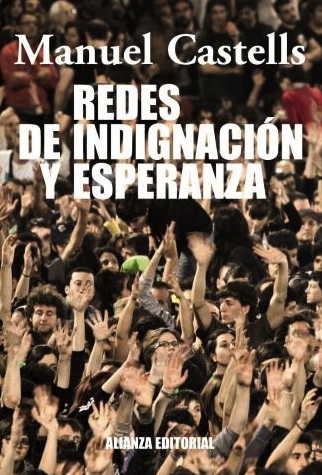 The most important emotions for social mobilization and political behavior are fear (as a negative emotion) and enthusiasm (as a positive emotion). Fear is overcome by sharing it and identifying with others in a collective action. Individuals are enthusiastic and mobilized for a goal that matters to them, and from this relationship arises the hope of the alternative to the current situation. As the title of his work reflects, protest for Castells is the expression of indignation, when individuals meet others and their minds connect, indignation is transformed into hope and what began as a social movement of protest against a concrete injustice, is transformed into a cultural movement of creation of meaning, contestation of power and transformation of society.
A new model of collective action
Although historically, social movements have always needed specific communication mechanisms, press, radio, sermons, pamphlets, etc. The networked social movements of the digital age represent a new species of social movement. What are the specific elements of these movements that make them agents of social change in the networked society? These are their common characteristics, according to Castells:
- They are spontaneous in their origin. They are generally triggered by a spark of indignation related to a specific injustice or because society has lost confidence in its rulers and has reached the limit of its patience in the face of injustice.
- They are networked, so they do not need a defined structure of formal command and control or specific hierarchical leadership. The redarchic structure itself protects it from the dangers inherent in traditional party apparatuses: clientelism, bureaucratization, and manipulation.
- They are viral movements. They follow the communication logic of social media, using the viral nature of the images of protest actions and the dissemination of messages and slogans strongly felt by society; “they do not represent us”, “together we can”.
- The space of autonomy achieved between the flows and interactions in social networks and the symbolic spaces occupied during protest mobilizations (squares, buildings, etc.) is the new spatial form of networked social movements.
- They are movements of self-reflection. They constantly question the objectives to be achieved and the most appropriate messages for collective mobilization. They continually question themselves as movements and as individuals.
- They are nonviolent movements. Although they necessarily have to occupy public spaces to make their presence visible, the vast majority of the participants are not violent individuals and are usually limited to peaceful civil disobedience. Obviously there are exceptions, but the intention of these movements is to occupy political power through democratic means.
- They are not programmatic. Their demands are multiple and emotional, their concrete proposals in each case depend on collective deliberation and consensus. They do not follow a specific program, so it is difficult for the traditional parties to integrate them into their bases. Their objective is to change the values of society and change the state of things that they consider unjust.
- They are political in the sense that their ultimate goal is to change the values of society and question existing institutions and political parties. Their proposal for change is a new utopia: “to transform people into protagonists of their own lives by affirming their autonomy with respect to the institutions of society.”
- They are both local and global. They start with concrete mobilizations, but soon connect in global networks, learning and drawing inspiration from the experiences of similar movements in other parts of the world.
Changing minds to change society
 One of the book’s strongest ideas is the premise that the ultimate battle for social change is ultimately decided in people’s minds. The construction of meaning in the human mind is a stable and decisive source of power. The way we think determines the fate of the institutions, norms, and values that structure societies.
Human beings build meaning by interacting with their natural and social environment. In other words, the connection between the networked social movements that we are experiencing and the long-awaited democratic regeneration of our society occurs in people’s minds. Although political change is limited by the interests of the parties and institutions that govern us, the influence of political movements in politics is real and lasting, to the extent that the ultimate goal of these movements is to raise awareness among people, and make them see the poor quality of our democracy and the social injustice that permeates our society.
In our country we can already say, without risk of error, that these networks of indignation and hope have put an end to the dominant two-party system, forcing a new political ethic and changing the way of doing politics of the traditional parties. They have also made possible the emergence of new actors, parties and coalitions that today govern the most important capitals of the country. And what is even more important, they have opened up the hope of a regeneration of our democracy, which without their appearance would have been impossible.
Discover more from José Cabrera
Subscribe to get the latest posts sent to your email.


