
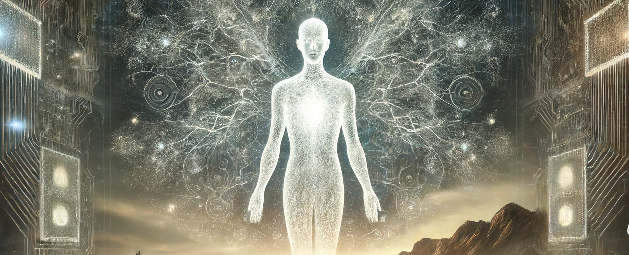
“Through the continued development of biotechnology and AI, we have entered an era in which life will be designed by intelligence, rather than evolution. The rapidly growing power of these technologies means that these changes will be profound and dangerous.” Nick Bostrom
Superintelligence, an artificial intelligence that far exceeds human cognitive capacity, has ceased to be an exclusive topic of science fiction to become a real concern in the technological and philosophical field. This post explores the risks and challenges that superintelligence poses from a philosophical perspective, based on current knowledge on the subject. We will reflect on problems that, until recently, seemed mere literary occurrences and are now serious topics of academic and ethical debate.
From the possibility of an automated world government, evoking the classics “Brave New World” by Aldous Huxley and “1984” by George Orwell, to the plausible catastrophe for humanity derived from the malfunction of machines, as has been seen in films such as “2001: A Space Odyssey” by Stanley Kubrick, “Terminator” by James Cameron or “The Matrix” by the Wachowski brothers. In addition, we will consider the possibilities and limitations of AIs with human values, reflected in these and other works. The movie “Her,” for example, features a personal assistant with emotional capabilities so advanced that he even falls in love, showing another facet of the interaction between humans and artificial intelligences.
Like children finding a new toy, we play with technologies whose complexity and consequences we don’t fully understand. This act reflects our curiosity and our desire to explore, but also our recklessness and lack of understanding of the risks involved. Superintelligence is a challenge that demands a level of preparation and responsibility that we have not yet reached. We need to make significant progress in our understanding and handling of these technologies to mitigate the existential risks they pose.
Through this post, we propose to address these challenges of superintelligence with a serious and rigorous perspective, supported by current scientific and philosophical knowledge. We invite readers to explore with us how these scenarios, which once seemed like mere science fiction, are taking shape in our real world and what implications they have for our collective future.
What is Superintelligence?
Artificial superintelligence is a hypothetical AI system that would have “an intellectual reach beyond human intelligence.” This involves not only exceeding our abilities in specific tasks, but also in creativity, problem-solving, and emotional understanding. Superintelligence is not limited to replicating human intelligence; he seeks to transcend it in all possible aspects.
 The concept of superintelligence has evolved since the first ideas of artificial intelligence in the 50s. Alan Turing, with his famous “Turing Test”, and John von Neumann raised the first questions about the possibility of superintelligent machines. Over the decades, AI has advanced significantly, from simple processing algorithms to sophisticated neural networks capable of deep learning.
In recent decades, figures such as Nick Bostrom have delved into the existential risks associated with superintelligence. In his book “Superintelligence: Paths, Dangers, Strategies,” Bostrom examines the possible trajectories that the development of superintelligence could take and the ethical and practical challenges it poses.
Currently, there is only Specific artificial intelligence, programmed to perform specific tasks often at a speed greater than human, but it cannot function beyond its designated function. This type of AI, also called ‘weak AI’, includes everything from virtual assistants such as Siri or Alexa, to generative language predictive models, such as OpenAI’s ChatGPT.
On the other hand, artificial general intelligence is an aspirational state of AI that resembles human intelligence in a wide range of tasks and can learn and adapt to new situations in multiple domains in a similar way to humans. This would include the ability to understand and reason in various domains, learn flexibly and creatively, have common sense, plan, and adapt to new and unfamiliar situations. Also called ‘strong AI’ because it would not require human intervention in its training and could perform practically any task autonomously.
Artificial superintelligence is considered a hypothetical future stage in the evolution of AI in which machines would be able to outperform humans in terms of cognitive abilities, creativity, problem-solving, and adaptation to a wide variety of domains and situations. The idea of superintelligence is speculative, and to date, no AI system has been achieved that meets all the criteria for superintelligence as described in science fiction literature and philosophical reflection. This type of AI would surpass human cognitive capacity, being able to think, reason, and make cognitive judgments beyond people’s capabilities. In addition, they could even develop emotions, needs, and have desires of their own. For now, superintelligence is a theoretical concept, but if it were to materialize, it would represent an unprecedented change in human history.
What is singularity?
“The Singularity is the future stage of human evolution, a time when the pace of technological progress will become so rapid and its effects so profound that they will irreversibly transform our existence. Through technology, humanity will succeed in overcoming the constraints that our biology has placed on us.” Ray Kurzweil
The technological singularity is a concept that refers to a point in the future where the growth of technology, especially in the realm of artificial intelligence, becomes so rapid and profound that it results in irreversible changes in human civilization. This concept suggests that, once a superintelligence is created, its ability to self-improve and evolve technologically could far exceed our understanding and control, leading to exponential growth in intelligence and technological capability.
 It is critical to understand that the Singularity is not simply about technology; It’s about the profound impact this technological acceleration will have on our civilization, our biology, and our identity. It is not simply a progression of human history; It’s an event that, in many ways, will break with human history as we know it.
The Singularity asks us to reflect deeply on who we are and what we want to become. It challenges us to make conscious ethical and moral choices as we forge our future. Simply put, it’s a total game-changer and something everyone should understand because it will affect every aspect of our lives. We’re talking not just about advancements in tools or external technology, but also about how those tools could merge with us, enhance our capabilities, and possibly expand our consciousness.
Understanding the Singularity is crucial because it confronts us with fundamental questions about who we are, what we value, and how we want to shape our future. It is a call to action to guide this advancement in ways that benefit all of humanity and preserve what we value most deeply as human beings.
Existential risks
An existential risk is any risk that has the potential to wipe out all of humanity or, at the very least, kill large sections of the world’s population, leaving survivors without sufficient means to rebuild society to current living standards. These risks are distinct from less extreme global catastrophic risks, although both can have devastating consequences.
Until relatively recently, most existential risks were natural. These include volcanic eruptions that can cover large areas with ash, blocking sunlight and causing volcanic winters, such as the case of Vesuvius that buried Pompeii in 79 AD. Another example is asteroid collisions with Earth that have led to mass extinctions in the past, such as the one that wiped out the dinosaurs. These natural events have caused mass extinctions millions of years ago, and although they are rare, they are still a threat.
The technological advances of the last century have brought enormous benefits, but they have also introduced new existential risks: Nuclear war was the first man-made global catastrophic risk. A global war could kill a large percentage of the human population. In addition, the nuclear winter resulting from such a war could be even deadlier, with effects such as the destruction of the ozone layer, severe global cooling, and crop failure, potentially killing most people on Earth.
New advances in biotechnology offer the opportunity to save and improve lives, but they also increase existential risks. Genetic manipulation could create more lethal and contagious pathogens, and could reduce the genetic variability needed for long-term adaptation and survival.
Artificial intelligence, once the exclusive subject of science fiction, has made significant strides. AI has the potential to improve lives in unimaginable ways, but it also poses risks. The possibility of an artificial superintelligence reaching such a level of power that it can dominate the world is not just science fiction speculation, but a risk that must be taken seriously. The combination of rapid accumulation of knowledge, accelerated technological innovation, superior strategies, effective manipulation, and self-improvement presents a set of challenges that could threaten the very existence of humanity. The scientific and philosophical community must continue to explore these risks and develop strategies to mitigate the potential dangers of runaway superintelligence
Loss of control
If an existential catastrophe were to threaten us as a predetermined result of an explosion of intelligence, our thinking must immediately turn to the search for countermeasures. Superintelligence poses a significant risk precisely because, once a certain level of cognitive ability is reached, its behavior could become uncontrollable and potentially dangerous to humanity.
Is there a way to avoid this expected outcome? Is it possible to design a controlled detonation of superintelligence? These questions underscore the urgency of developing effective strategies to maintain control over advanced artificial intelligences. Nick Bostrom in his book “Superintelligence: Paths, Dangers, Strategies” proposes two major possible methods to deal with this problem: ability control and motivation selection.
Capacity Control: Capacity control refers to the limitation of what a superintelligence can do. This involves establishing technical and operational barriers that restrict the actions and scope of AI. Some strategies within this approach include: Maintaining superintelligence in a controlled environment where its capabilities are limited by physical and digital security measures. This could involve using closed systems that prevent access to external networks and tightly controlling superintelligence’s access to sensitive data and powerful resources.
Constant Human Supervision: Implement constant human oversight over superintelligence activities, ensuring that all their actions are monitored and, if necessary, intervened. This requires the creation of interfaces and protocols that allow humans to maintain direct control over critical decisions.
Motivation Selection: Motivation selection refers to the programming of superintelligence with goals and values aligned with human interests. This approach seeks to ensure that the actions of AI and the goals of superintelligence are directed towards beneficial outcomes for humanity. Some strategies This involves regulating the use of learning algorithms so that they incorporate ethical and moral principles into AI decision-making.
Implementation of Human Values: Program superintelligence with a set of core values that guide its behavior. These values must be carefully selected and codified to ensure that AI acts safely and ethically in a variety of situations.
Ethical and Philosophical Challenges
Superintelligence poses a number of profound ethical and philosophical challenges that require careful reflection. As artificial intelligence (AI) advances, it is crucial to consider the ethical and philosophical implications of these developments. These challenges include questions about the conscience and morality of AI, the philosophical issues associated with autonomous decision-making, and the responsibilities and rights of a superintelligence. In addition, it invites us to reflect deeply on our identity and values, and how we want to shape our future in a world with superintelligence.
Conscience and Morality: The possibility that a superintelligence can develop consciousness raises fundamental questions about the nature of these machines. Consciousness involves having subjective experiences, and if an AI reaches this level, we need to ask ourselves if it should have human-like rights. In addition, AI’s ability to make autonomous moral judgments is a significant challenge. Currently, AI systems have no inherent understanding of morality, which poses risks if their decisions are not aligned with human ethical principles.
To address these challenges, it is crucial to develop algorithms that incorporate sound ethical principles. Researchers can work on programming moral values directly into AI, ensuring that their decisions are guided by these principles. In addition, it is necessary to create legal and ethical frameworks that recognize and protect the rights of conscious AIs, if they come into existence. Continuous monitoring and the ability to update these systems with new learnings and moral values are also essential to maintaining ethical alignment with humans.
Autonomous Decisions: The ability of a superintelligence to make autonomous decisions without direct human intervention raises philosophical issues related to free will and responsibility. If an AI can act based on its own analyses and criteria, we must consider whether these decisions are truly autonomous or simply the result of its programming. In addition, autonomous decision-making can have significant consequences, and it is crucial to determine who is responsible for these actions.
To handle autonomous decision-making, regulations and oversight mechanisms must be implemented to ensure the transparency and reviewability of AI decisions. This includes creating legal frameworks that clearly define liability in cases of harm caused by AI. Additionally, developing AI systems that can continuously learn and adapt to new ethical contexts can help ensure that their decisions remain aligned with human values. Collaboration between experts in ethics, law, and technology is critical to creating comprehensive and effective solutions.
Responsibility and Rights: The question of responsibility is crucial when considering the autonomy of a superintelligence. An AI’s decisions and actions can have significant impacts on society, and determining who is responsible for these impacts is essential. Also, if a superintelligence reaches a level of consciousness, we need to consider whether it should have rights similar to those of humans, such as the right to exist and not be exploited.
To address these challenges, new legal frameworks and regulations need to be developed that address the liability of AI actions. This includes clearly defining who is responsible when an AI causes harm, whether it is the developers, operators, or the AI itself. In addition, it is critical to consider creating rights for conscious AIs, ensuring that they are treated ethically and fairly. Continuous monitoring and updating of these legal and ethical frameworks are essential to adapt to technological advancements and protect both humans and AIs.
Shaping the future
As we move towards a future where artificial intelligence could solve global problems such as climate change, disease, and the need to work, it is crucial that each of us takes an active role in this transformative process. Here are a few ways you can contribute:
- Educate yourself: Deepen your knowledge about AI: Understanding both the benefits and risks of artificial intelligence is essential to participate in informed discussions about its future. Read books, articles, and studies on AI and stay up to date with the latest technological advances.
- Share Knowledge: Educate others about the importance of AI: Use social platforms, blogs, or even everyday conversations to spread information about the challenges and opportunities presented by AI. By sharing knowledge, we can raise awareness and encourage informed public discussion.
- Join the Conversation: Participate in forums and seminars on AI: Your voice matters to ensure that diverse perspectives and values are considered in the development of artificial intelligence. Get involved in discussion groups and events that deal with AI to contribute your ideas and concerns.
- Support Responsible Policies: Promote and support ethical policies: Get involved in local and global initiatives that seek to regulate and guide the use of artificial intelligence in a safe and ethical way. Advocates for policies that protect human rights and ensure fair technological development
- Vote with Conscience: Consider candidates’ AI positions: When choosing representatives and leaders, consider their policies and positions on technology development and artificial intelligence. Informed leaders can push for laws and regulations that protect society from the potential risks of AI.
- Foster Ethical Innovation: Develop safe and ethical solutions: If you’re in the tech field, work to create AI solutions that are beneficial to all of humanity. Prioritize safety, ethics, and responsibility in your technological developments.
- Adapt to Changes: Prepare for the future of work: Changes in the labor market and social dynamics due to AI are inevitable. Consider ongoing training and learning new skills that will be valuable in a technology-driven future. Stay flexible and collaborate with AI as an extended professional.
Artificial intelligence has the potential to transform our society in profound and beneficial ways. However, to ensure that this transformation is a positive one, it is crucial that each of us actively participates in the process. No matter your level of experience or seniority, there’s something you can do to help us ensure that the future of artificial intelligence is a positive one. Join the conversation and collaborate with us to forge a future where superintelligence is a tool for the greater good, not an existential threat.
Discover more from José Cabrera
Subscribe to get the latest posts sent to your email.


