
We live in the permanent contradiction of experiencing the reality of uncertainty, and the belief that we can still choose the fate of our lives and that of our organizations.
Ralph D. Stacey
Every day it is more obvious that our leaders do not have the answer. Despite this, most books on leadership, and the best business schools, continue to deny the obvious: our inability to manage, predict or control what will happen in a context like the current one of extreme volatility. We remain committed to applying, on a new and volatile territory, tools designed a century ago, designed for planning, control, certainty and predictability.
The fundamental premise remains that the leader’s job is to choose the future state of the organization, and guide its development in that same direction. However, our experience shows us, every day, that in a global, complex and uncertain world, organizational reality is not plannable; that emerges as a result of countless unpredictable interactions and interests; and that the knowledge and experiences that we have been accumulating in our passage through the previous scenario, end up becoming dysfunctions and serious errors when applied to the current systematically disruptive context.
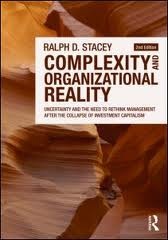 The growing social, economic and political uncertainty demands from us, therefore, a good dose of humility. Humility to recognize that the territory has changed significantly, and that we urgently need new maps that allow us to explore the future. Therefore, in today’s reflection, I propose that we relax our mental models and enjoy the company of Ralph Stacey to enter the emerging world of the sciences of complexity and uncertainty. The first step is for you to open your mind. Think that the possibility of understanding the new context does not depend on the clarity of the facts, nor on the amount of information we have, but that, today more than ever,
it depends on our ability to create new perspectives of reality, to integrate new experiences and develop new forms of collective action.
The reality of uncertainty
As Nassim Taleb explains in his book “The Black Swan”, we find ourselves in a new world, dominated by the unknown and the unpredictable. We are facing an emerging future, in which we are all part of the problem and the solution, and in which, in order to address new challenges, we must assume that “what we don’t know is more important than what we know”. So much so that the growing complexity of this global world, interconnected and made up of countless actors, leads us to think that stability, in the new scenario, will be the exception in a structurally unstable environment. Hence, this is precisely one of the first questions that Ralph poses to us in his book: Why do we continue to talk, explain and prescribe solutions to our current challenges on an intellectual basis that completely contradicts experience? His proposal for the Age of Collaboration is surprisingly simple:
“We need to stop fantasizing about what organizations should be, and dedicate ourselves seriously to exploring the reality of the lives of our organizations”
And that’s exactly what we’re going to try to do in the following paragraphs.
Organizations are conversations
In his book, Ralph proposes that we see organizations as they really are, as adaptive systems, that is, as conversational interactions between people and power relations in which decisions are negotiated based on specific ideologies and interests, where organizational continuity and changes emerge unpredictably instead of being the result of a predefined global plan. Organizations are conversations, insofar as organizational reality emerges as a result of the conversations that -day after day- take place between the members of the organization, and the conversations between the members of the organization and their customers and partners. After all,
It is the experiences that emerge in these ordinary conversations that establish the power structure, the relationships of inclusion and exclusion, and the very identity and values of the organization; It is these interactions and relationships between people that shape the reality of the organization, that transform that same reality and that, in addition, decide its future. And the carefully planned hierarchical order is really replaced, in the day-to-day of the organization, by an order that emerges from instability through processes of self-organization. The main implication of this reality is the following: we need to shift focus and attention from processes – as we have done so far – to people and their interactions. Something that is not going to be easy, especially if we take into account that this one we propose is not precisely the dominant perspective.
Traditional management literature focuses on the science of certainty, rather than on the science of complexity and uncertainty. And this forces us to ask ourselves the following question: how to make the right decisions in the new environment when the rational process cannot be applied, and analytical techniques are incapable of establishing the future direction? My bet is clear: Uncertainty is managed with more dialogue and interaction and less hierarchy and planning. Our 2.0 organizations must be, essentially, conversations, people-centered organizations; organizations capable of attracting and retaining the talent of the first generations of digitally native professionals. Being competitive in the face of uncertainty presupposes above all the ability to adapt to changes. This implies that our organizations will have to be not only competitive, but extremely agile, capable of innovating and adapting to a complex and structurally unstable environment; that they must be more open organizations, without functional borders, transparent in their management and capable of co-creating with their customers and partners. Organizations, in short, in which leadership and innovation will be everyone’s job, and not that of a privileged few located at the top of the organizational pyramid.
Self-organization and emergency
Ralph Stacey proposes to analyze the reality of organizations from the perspective of the sciences of complexity and uncertainty. The recognition that organizations are the result of a multitude of interactions, as is the case with living beings and other complex systems, leads us to affirm that, as with living beings, The ability to adapt is a driving force behind organisational changes.
But how is a complex system organized? A complex adaptive system consists of a large number of agents, each of which relates to the others following its own local principles of interaction. This means that complex systems do not obey predetermined laws. Instead of being governed by them, agents interact according to their particular interests. And although in most cases there is no explicit coordination of interactions – or precisely because of that – the truth is that order ends up emerging naturally. Self-organization is one of the key concepts in the sciences of complexity. It is an organizational process/form in which there is no central coordination, neither internal nor external to the organization. In contrast to centralized organizations – in which power is deliberately exercised through formal or informal mechanisms of control – in self-organized networks, as is the case in redarchies, agents act and behave in an exploratory and experimental way. And emergence is another concept that helps us understand the dynamic process by which a higher order emerges – in an unpredictable way – as a result of the multiple interactions that occur in self-organized organizations. Emergence is, therefore, the new order. A new order that results from the dynamics of interactions, which is not marked – as in hierarchical organizations – by direction and control, and which, unlike iron and inflexible hierarchical structures, is capable of responding to the exceptionally complex challenges we face.
Leadership and uncertainty
Both themes, self-organization and emergence, help us to reflect on the true nature of leadership, and allow us to focus the reflection not so much on the leaders who “act” on organizations – a mere illusion in times of uncertainty – but on somewhat softer but at the same time much more definitive aspects, such as the conversations, perceptions, motivations and values that guide the functioning of these organizations. The starting point is to understand that the work of leadership as an adaptive process is not a prerogative of leaders, but the emerging result of the relationships between the people in the organization. Therefore, complexity management requires promoting leadership at all levels, to ensure that leadership becomes the work of everyone, and not only – as has been the case until now – of a select few at the top of the pyramid. Adaptive leadership therefore requires a greater focus on interactions and people. As adaptive leaders, we must be able to influence others, and create the conditions that facilitate the emergence of new solutions. We must encourage collaboration and participation by all, an open culture and transparency in interactions, always bearing in mind that innovation arises according to the way interactions are governed and facilitated. And we must facilitate communication and co-creation between the different nodes of the organization, to develop human and social capital to the maximum. All without forgetting that the ultimate goal is emergency. And emergency is the opposite of control, command and control, abuse of power and opacity.
Redarchy and uncertainty
The fact is that we cannot address complexity and uncertainty using current bureaucratic structures. The response to today’s challenges must be collective. And that means that we must explore alternative structures, new forms of organization that allow us to collaborate, and generate new spaces for contribution located beyond traditional limits. Think that, today, within organizations, people achieve their goals by interacting with a small number of people; that is, through local interactions. These local interactions mean that each team, group or department has its own ways of doing and relating. And they are strongly conditioned and limited by the hierarchical structure, by the reporting structures, by the division of labor and, very particularly, by the obligation to do what is considered right in the organization; that is, by its values and culture. The traditional organizational model constrains us, and prevents us from giving an adequate response. Reality shows us every day that, in times of uncertainty, functional hierarchical structures – operating divisions – compete with each other, fight for internal resources, and often forget that, in an unstable and unpredictable environment, collaboration is the most powerful way to create value. They forget, therefore, that collaboration and trust are key to organizational adaptability and flexibility in an increasingly complex and global environment. New communication spaces – blogs, tweets and social networks – are having a real impact on work environments, processes and the structure of our organizations. The new generations of digital natives – newcomers to organizations – learn, innovate, collaborate and do things substantially differently from previous generations. Hence, the need to create new, more dynamic structures and contribution frameworks, which make innovation and differentiation possible at all levels. And hence my proposal, which involves the development of a new complementary redarchical structure , which makes up for the obvious shortcomings of the hierarchical organizational model, and replaces it step by step, at the pace that the organization needs. As I have already explained in other conversations, the network emerges as the natural structure of new networked organizations, facilitates innovation and makes it possible for creative people to opt for those contributions that motivate them the most, and that best align with their own skills. In the network, tasks can be chosen and not imposed, and the decision-making capacity of each person is determined by their personal reputation and the added value they bring to the organization. That is why I think that, in the face of the unpredictable, a dual hierarchy-network structure can ensure the necessary sustainability and scalability and, at the same time, is able to remain agile and flexible in its interactions with the environment.
By way of summary
The radical thing about Ralph Stacey’s proposal is that it forces us to change the dominant discourse in the face of the crisis: instead of devoting all our energy to looking for those responsible in our leaders, governments, companies, institutions, etc., we should spend some time recognizing that the reality of uncertainty is something that we have created together; an unplanned result, which results from the emergence of our own values, actions and omissions. Hence the importance of our leaders stopping talking about what they and we are going to do, and start talking about what they and we actually do.
In the same way that civilizations are not the result of any kind of long-term planning, organizations and their culture are not the result of specific planning, but of the emergence of interactions and power relations between the people who form them. That is, of the interactions between people themselves. The legacy of objective, structured and predictable organizations is not enough to address the future. It is necessary to advance in the design – as we have already done in other sciences – of a non-linear management model, which can contain emerging events and is capable of generating actions based on the monitoring of relationships, and attention to trends, ruptures and discontinuities. In this sense, the thesis of this author is the following:
“The best way to prepare to act is not to try to guess what’s ahead and look back, but to perceive the dynamic that brought us here and learn from it.”
So to successfully emerge from the current crisis we are going to need more than just budgetary adjustments, financial control measures or new safe European bonds. Perhaps we should, as Ralph proposes, start by radically rethinking what our leaders, executives, managers and what we all do every day in our organizations. The good news is that in the sciences of uncertainty, the possible is always more edifying than the real.
Discover more from José Cabrera
Subscribe to get the latest posts sent to your email.


