
Trust emerges when leaders are transparent, honest, and keep their word. It’s that simple.
Jack Welch.
Collaboration is, today, the most powerful way to create value. This is because the challenges we face are so complex that our leaders do not have the answers. The answer can only be collective. That is why we say that, in the new global and networked economy, sharing creates value; that networks are the new organizational chart and that the Netarchy It is the emerging new order. A new order that is not based on the power and authority of the formal hierarchy, but on the relationships of participation and flows of activity that naturally arise in collaborative social networks, based on the added value of people, authenticity and trust.
Confidence in work is an imperative
This leads us to affirm that trust is not a mere “desirable cultural value” in organizations, but constitutes a real economic imperative, insofar as it generates a favorable productive climate, allows us to collaborate to innovate, provides us with the agility of execution that we need to adapt to changes and, as a consequence of all the above, translates directly into the income statement.
Collaboration: teamwork
The fact is that there is no collective innovation without collaboration, and there is no collaboration without trust
In other words, in the Age of Collaboration, an organization can only be truly competitive when it makes the most of the new ways of doing things, and the new models of collaboration that Social Business
offers us. And the use of the social technologies that support it is only possible within a culture of trust, since trust is essential to generate productive interactions between people and between organizations.
Today’s reflection, therefore, is on the urgent need to regain trust at all levels. The myriad interdependencies that characterize the world in which we live reinforce the urgency of this need, and make trust a real survival imperative for society: without personal trust, without trust in others, without trust in our democratic institutions and in our political leaders, we will hardly be able to overcome the financial crisis and the enormous challenges of the Age of Collaboration.
A culture of trust is key to overcoming the current crisis
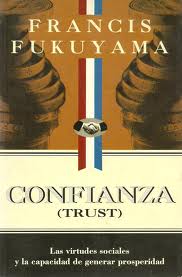
In his book Trust
he drew attention to the importance of culture as the final determinant of economic life. There he explained that people’s needs go beyond the mere desire to make profits; that, as members of a society, people are trapped in networks of relationships and commitments; and that, to a large extent, cultural ties determine economic decisions. Hence, in reality, the financial crisis is essentially a crisis of confidence at all levels. Citizens do not trust the abilities of their political leaders to solve the enormous challenges we face, and the indignados show us every day their disaffection with an inoperative and unjust social model. Thus, according to the Trust Barometer -trust index published annually by the Edelman agency- in Europe trust in political parties is only 8%; that of governments is at 27%; trust in large companies has fallen to 12%; and only 22% of those surveyed trust the media.
The figures of the El País barometer, which analyzes trust in our institutions, are even more alarming. On a scale of 0 (no trust) to 10 (total trust), the interviewees give a 2.8 to political parties, a 3 to the current government, a 5.2 to large Spanish companies, and a 4.7 to newspapers. Doctors and scientists are at the top of the list with 7.4 and curiously the Armed Forces, which were the mainstay of the dictatorship, are today perceived as a mainstay of democracy with a score of 6.5.
The causes of this situation are different in different countries, but their effects on social distrust, rating agencies and markets are very similar.
The real risk in companies is in the absence of trust
In the field of companies, management emerged – in some way – as a discipline to make things increasingly predictable; that is, to eliminate risk and uncertainty. But in the current scenario, this starting assumption has simply proved to be unfeasible. The future is increasingly unpredictable, changes are happening at an accelerated pace and, since there is no way to predict what is going to happen, the only thing we can do is, on the one hand, create the conditions for new collective solutions to emerge, and on the other, adapt to change with agility, something that is only possible in an environment of trust.
The idea that trust in others is directly associated with greater risk is, in part, a consequence of the starting assumptions of traditional management, already refuted by the facts. The Industrial Age demanded an army of obedient operators, subject to tight hierarchical control. But today no one doubts that this same army – inflexible, devoid of passion and creativity – would be incapable of innovating and adapting to changes; in short, that it would have no chance of surviving in the current circumstances.
As Stephen Covey points out in his book The Speed of Trust
), in an uncertain, changing and fast-paced world such as today’s, the risk is not – as has traditionally been understood – in the trust we place in others, but in the absence of trust. And this is because an organisation based on fear and control, on suspicion and supervision, is much less agile when it comes to adapting to changes than an organisation based on a culture of trust; that is, based on the alignment of people, transparency, responsibility and reciprocity.
In fact, a culture of trust makes the ability to execute much more agile and faster, and translates directly into results. The cost of executing without trust is much higher, since it involves the deployment and maintenance of a complex control system, and a veritable army of supervisors who provide no value to the organization other than their own threatening shadow.
In addition to being ineffective and costly, this control system is oppressive and depressing for the people who work in the organization, and curtails a good part of their creativity, their desire to innovate, to change things, and to do them in a different way. That is why we say that, in organizations, the risk is not in trust, but in the absence of a culture of trust.
Trust is, therefore, an essential issue, and there is a direct correlation between trust and results. Not surprisingly, trust is directly related to economic performance, employee satisfaction, their commitment to the organization, their decisions; and, as Covey points out, also to the speed of execution.
The proof is that companies with a good culture of trust – those that appear at the top of the “100 most trustworthy companies” report
“- perform up to three times higher than those without. And in the results of this year’s Edelman report, for the first time, trust and transparency are as important to corporate reputation as the quality of products and services.
Creativity, innovation and passion – key values of the new era – can only happen in an environment of trust
The representative values of the Industrial Age were efficiency and scalability. But, in the new era there are new demands. It is no longer as important to predict and obey as it is to create, innovate and change. As a result of these changes, the elements that are currently at the top of the value-added pyramid are creativity, innovation and passion.
It is evident that these values are impossible to develop in an organizational structure that is alien to trust.
That’s why when we say trust is a business imperative, it’s not a rhetorical statement. Trust is the real key to innovating, collaborating, getting the best out of our customers.
digital natives
and create 2.0 organizations; also to develop the new forms of leadership that we need to face the future.
The enemies of trust
Trust has many enemies: the tight hierarchical control exercised by the top of the pyramid; the pressure of armies of supervisors and controllers, which restrict any type of innovative initiative; hidden agendas, inconsistent messages, unfulfilled promises, inequitable behaviors, unproductive silos, communication gaps, destructive rumors in the coffee machine… In short, the enemies of trust are those we have already identified on other occasions as “passion killers”, all those elements that reduce the enthusiasm and creativity of the people who are part of the organization.
Creating a Culture of Trust: Where to Start?
The good news is that trust is not just a behavior we can learn but a character trait we can develop. We must always build trust from the inside out: from our own self-confidence, from our trust in others. Somehow, we must be able to build trust and inspire others to do the same.
As Covey tells us, trust operates like a bank account in which we can make deposits and withdrawals. This is how we enter and trust increases when we show our interest, respect and empathy towards others, we keep our promises, we are open to new ideas, we do not pretend to have all the answers, we have the humility to recognize that we have made a mistake, we seek collaboration and we build relationships in which we all win. On the contrary, trust decreases when we treat others with arrogance and pride, we break our promises, we manipulate others for our own benefit, we pretend to always be right, we are disloyal and spiteful, we operate with a hidden agenda, and when we seek to build only relationships in which only we benefit.
Thus, from a personal point of view, maintaining the balance of trust on the positive side, we can all contribute to making trust a social value; an accepted norm that serves as a basis for us to build – collectively – a better world.
If you’re in a leadership position, don’t forget that the ability to build and restore trust with your colleagues, collaborators, customers, and partners is the skill that will decide your future in this new networked global economy. Start by being the first to place your trust in others:
-Clearly communicate goals and expectations. Be direct, frank, and sincere.
– Be consistent and predictable. Fulfill your commitments. Have the courage to define yourself between what is right and what is not.
-Show respect for the ideas of others, listen and be close.
– Empower team members to take risks and act autonomously.
– Accept your mistakes and be tolerant of the mistakes of others. Create spaces and time for innovation.
– Be transparent. Make your contribution visible, don’t hide your agenda, act according to your values and beliefs and be an example of the change you want to achieve around you.
– Meets the objectives committed. Trust requires not only character, but also skills to achieve the results we have committed to.
– It builds trust and expands trust as a vital business priority. There is no innovation without commitment, there is no commitment without trust.
In short, think that, when you lead, the important thing is not to be right, but to have a committed and aligned team, where everyone can give the best of themselves. To achieve this, the fastest way is to gain the trust of others and have the trust of others.
It won’t take long for you to discover that trust translates into results.
At Cabrera Management Consultants, we have developed an
online program on collaborative leadership and team management
. A training program that will allow you to build agile, diverse, empowered and connected teams, where trust, collaboration and teamwork will be the fundamental axis to achieve collective innovation.
Are you interested in our program?
Contact us
, we will be happy to help you.
Discover more from José Cabrera
Subscribe to get the latest posts sent to your email.


