
It’s time to create, not plan. Your future is yet to be made and it depends on you, instead of spending energy trying to predict it, turn it into creating it.
In previous conversations about personal innovation we have seen how the present and the future are the two sides of our personal innovation map. The present is the continuous side where we exploit what we have and have learned throughout our lives, the future is the discontinuous side, it is not a mere projection of the past, but something new that we build every day and that emerges as a result of our actions and omissions.
My proposal in today’s reflection is very simple; since your future is not programmed but is something that is to be built and depends on you, you must dedicate all your energies to building it.
Innovating to grow professionally and personally
In times of uncertainty, deciding what we are going to dedicate our attention to and the scarce resources we have is crucial. If we want to To grow both professionally and personally, we have two alternatives: the exploitation of old certainties or the creation of new realities, that is,
investing in innovation
. The choice we make between these two options will determine whether this will be a year where we dedicate ourselves merely to survival or if it will be a year of profound changes in ourselves and in our lives.
When we use an exploitative logic we usually see the future as a reality external to us, in front of which we have to take a position and to do so we try to predict it in order to plan it. And from here, we set the specific objectives we want to achieve, we draw up a plan and we manipulate the current reality to achieve predetermined objectives. Exploitative logic is the analytics that we have been taught since we were children in schools, so we can say that it is our natural way of approaching problems. It is based on the premise that to the extent that we can predict the future, we can control it. This analytical or causal way of reasoning is particularly useful when the future is reasonably predictable, our environment is stable and we are clear about the objectives we want to achieve.
When we use an entrepreneurial logic to approach our future, we start from a different premise: we are the ones who create our own future. This is the natural way of reasoning in entrepreneurs and innovators. The entrepreneurial logic is particularly useful in complex and uncertain moments such as the current ones, since it moves us directly to action, to stop feeling victims of circumstances and encourage us to become true protagonists of our lives, convinced that to the extent that we are the ones who create our own future, we do not need to predict it to control it.
Many times we are convinced that we have to be in a certain way and it seems impossible to us that we can be different. We live trapped in a reality that others have built for us. The Challenge is in Leaving our “survival zone” to move towards our “Innovation Zone”; It is about experiencing changes as an opportunity to generate a new reality, exploring the future and taking advantage of it to renew our lives and ourselves, instead of limiting ourselves to surviving changes by incrementally improving what we have always done.
What can we learn from entrepreneurs?
How do entrepreneurs successfully start a new project? How do they explore the future? How do they deal with uncertainty? How do they manage risks? How do they deal with the possibility of failure? What distinguishes entrepreneurs from non-entrepreneurs?
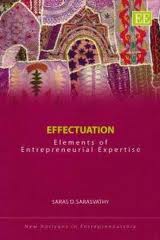
These are the questions that Saras Sarasvathy, an academic at the University of Virginia, explored in her study of successful entrepreneurs in the United States. Her biggest finding was that the way entrepreneurs reason is usually different from how other people do. In her study, Sarasvathy refers to “effectual” or “entrepreneurial” logic and the principle of “effectuation” as a way of approaching situations of uncertainty, which contrasts with the “causal” or “analytical” logic with which we normally approach problems and which we have already talked about a little above.
In other words, entrepreneurs do not develop a strategy and an action plan to reach certain objectives and for this they look for the necessary means, but they choose to act based on the means existing at the time, letting the ends be redefined in an adaptive way, which makes it possible for new opportunities to emerge as their project progresses.
Entrepreneurship as a way of life
From a business perspective, entrepreneurship is usually associated with the creation and management of companies, and practically all business schools treat entrepreneurship as an academic discipline, usually associated with the process of identifying business opportunities, developing a business plan, and finding the necessary resources to set up our own company.
From the perspective of Personal Innovation, the Entrepreneurship we have to see it as an impulse that leads us to Get out of our comfort zone to build our own future, focusing on what gives meaning to our lives and is important to us, taking smart risks when others choose security, moving resources from the past to the future and learning from our mistakes, transforming the contingencies we encounter along the way into future opportunities.
It is not about enriching ourselves with a brilliant idea, it is about enriching our lives forever. It is about going from managing what we know to Explore the unknown; We do not know the unknown because we do not see it, we do not have the tools to see it or we simply do not want to see it. It is about becoming true protagonists of our future, living aware that we are a “permanent beta” of an unfinished project, under permanent construction, which will need subsequent revisions to develop its maximum potential.
Five steps to start building your future
Entrepreneurs certainly have certain innate skills, but the important thing is that the principles they use to deal with uncertainty can be learned. If you want, you can start creating an alternative future for your life today by following the same steps they use to make their projects a reality.
- Try new things based on what you have. Your future is yet to be made. To create it, you must abandon any victimhood, that “it’s someone else’s fault”, to become the protagonist of your life. Throw small “Lifeboats” starting from what works in your life and stop overwhelming yourself by what doesn’t work. Focus on your assets, your aspirations and your closest reality. What are your passions? What are your skills and competencies? What do you know and like to do? Who do you know in terms of relationships and social networks? What makes you different, unique and difficult to achieve?
- Take smart risks, risk what you can assume. Risks are often the biggest impediment we have to take action. We all find it difficult to make decisions where the risk exceeds a certain threshold of discomfort. But believe me, in the current situation the biggest risk is to do nothing. Take on the risk that is affordable for you, don’t make it an all-or-nothing issue. As an entrepreneur you build your future, taking the smart risks and moving your resources from the past to the future. Entrepreneurship is chasing the opportunity beyond the resources available and controllable today and you must be willing to take risks, because otherwise it is impossible to advance your idea.
- Build real and lasting alliances. Look for collective intelligence. To make your idea a reality, surround yourself with trusted people, friends, and collaborators willing to commit to your initiative. Consolidating these commitments reduces uncertainty in the early stages of your new project.
- Consider contingencies as an opportunity to learn. This is the most distinctive skill of entrepreneurs: by not pursuing a closed goal, surprises are not seen as mistakes but transformed into learning opportunities. Start your journey willing to learn from the contingencies and mistakes you may make.
- Focus on doing something with the media under your control. Remember that your future is not something you can find or predict, it is something you have to create, so you must take action with the confidence that your actions will translate into results. Innovate by doing, try to put the emphasis on exploring, experimenting and creating something new with the means at your fingertips, instead of making big plans to achieve goals out of your reach.
Discover more from José Cabrera
Subscribe to get the latest posts sent to your email.


